
Onboarding
This section describes the different onboarding phases.
The onboarding phase consists of tenant provisioning and tenant configuration.Sinch provisions the tenant, and customer configures it. Tenant configuration consists of planning, designing, and implementing the configuration.
Sinch runs, maintains, and monitors the service, provides technical support to superusers, and manages related infrastructure and Sinch Contact Pro applications. The customer is responsible for their network and connections to the Sinch Contact Pro, integrations, and maintaining the configuration. Messaging services and a SIP trunk for voice calls can either be purchased from Sinch or a 3rd party supplier.
The Sinch Contact Pro deployment model is presented in the figure below.
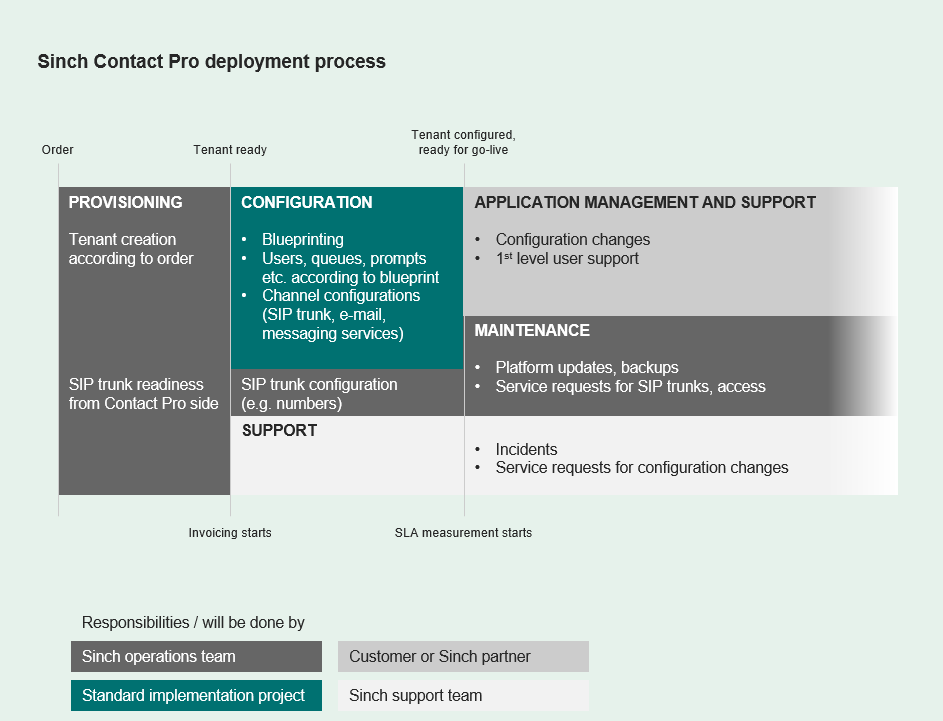
The main provisioning and configuration steps are listed below. Depending on the customer’s order, some steps may be irrelevant.
| Action | Phase | Responsible | Comment |
|---|---|---|---|
| Signing the contract | Provisioning | Customer/Sinch | Customer signs a contract with Sinch. The order triggers the provisioning of the tenant. |
| Tenant provisioning | Provisioning | Sinch | Sinch provisions the tenant and sends tenant ready notification to the customer. |
| Superuser account creation | Provisioning | Sinch | Sinch creates a superuser account and sends details to the customer. |
| Kick-off call | Configuration | Sinch | Sinch arranges kick-off call with customer/partner. |
| Messaging (Sinch Conversation API or Sinch SMS) | Configuration | Sinch | Sinch configures messaging channel integration. |
| Voice connection (Sinch Voice API) | Configuration | Sinch | Sinch configures the SIP trunk. |
| Voice connection (third party) | Configuration | Customer/Operator | Customer/Partner sends service request to Sinch regarding SIP trunk configuration. |
| Email configuration | Configuration | Customer | Customer/Partner configures email servers in the System Configurator application. |
| Chat and chatbot | Configuration | Customer | Customer/Partner configures chat and chatbot. |
| Integrations with standard APIs | Configuration | Customer/Partner | Customer/Partner completes integrations with standard APIs. |